
End-to-end (0→1) UI/UX design and data architecture for an AI-powered clinical trial recruitment system utilizing existing health records.
My Role(s)
Product Designer
Tools
Figma, ChatGPT (Protocol Parsing & AI Prompt Testing)
Industry
Healthcare / AI / Clinical Intelligence
Impacts
Ecosystem Portals
2 distinct dashboard experiences (Volunteer Portal & Clinical Recruiter Terminal), and 60+ high-fidelity screens across dual ecosystem portals
100% Clinical Governance
Validated by healthcare stakeholders for eliminating black-box AI risks through human-in-the-loop verification design.
.png)
Overview
A B2B clinical intelligence platform helping health clinics and community healthcare providers (FQHCs) use data to automate patient specialty referrals and clinical trial matching.
I designed the 0→1 product experience, from trial discovery through to recruitment decisioning.
PROBLEM
Clinical trial recruitment fails quietly. Sponsors lose months, sometimes years, not because patients don't exist, but because the systems for finding and qualifying them are broken.
Trial criteria are written for regulators
Trial inclusion and exclusion criteria are dense, highly technical, and difficult to parse quickly during patient visits.
High Cognitive Strain & Context-Switching
Trial inclusion and exclusion criteria are dense, highly technical, and difficult to parse quickly during patient visits.
How do you design confidence into an AI-driven matching system when the stakes are a patient's care and a sponsor's timeline?
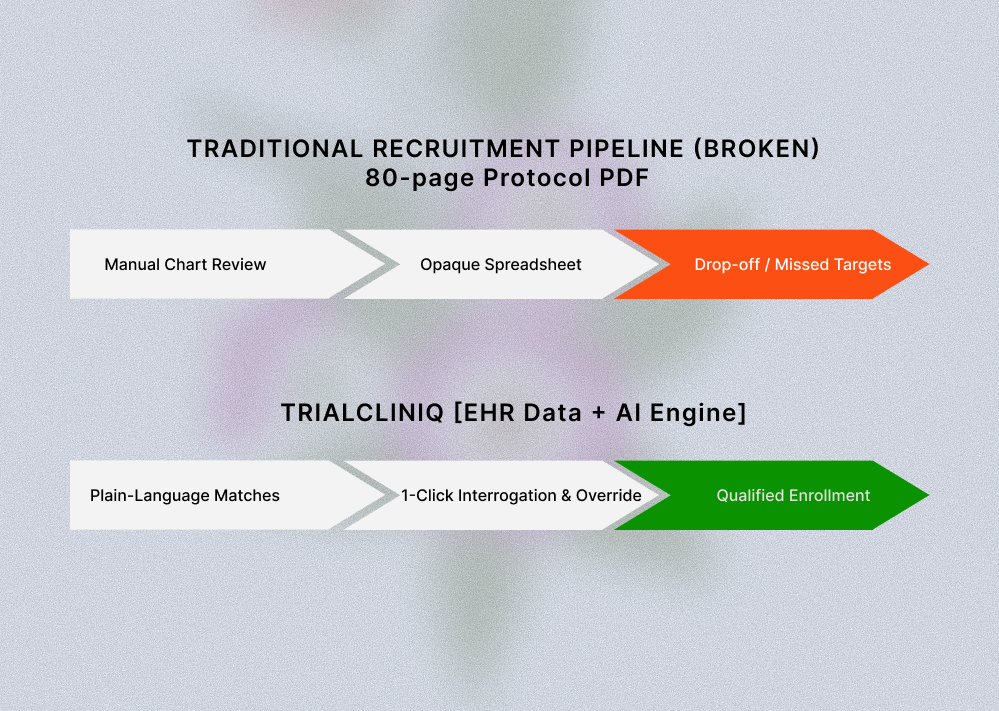
RESEARCH
Leveraging my background in Pharmacology, I approached research not just as a UX designer, but with an acute understanding of how clinical protocols and medical data operate in the real world.
1. Protocol Deconstruction & Desk Research
Before drawing a single frame, I analyzed dozens of active trial protocols from ClinicalTrials.gov and FDA regulatory submissions.
- Key Takeaway: Protocols rely on conditional logic matrices (e.g., HbA1c > 7.5% AND no history of renal impairment within 12 months). The AI interface needed to expose this underlying logic, rather than hiding it behind a single percentage match score.
.png)
Volunteers Core Need:
Clear, empathetic language, simplified eligibility checks, and control over personal medical data sharing.
Recruiters/Investigator Core Need:
Rapid screening tools, instant audit trails, and zero friction to interrogate or override AI matches.
THE SOLUTION
Transform complex AI clinical matching into a transparent, human-governed, and lightning-fast UI experience.
Rejected Ideas & Critical Pivots
Like any complex 0-to-1 system, the best design decisions came from testing and eliminating flawed approaches
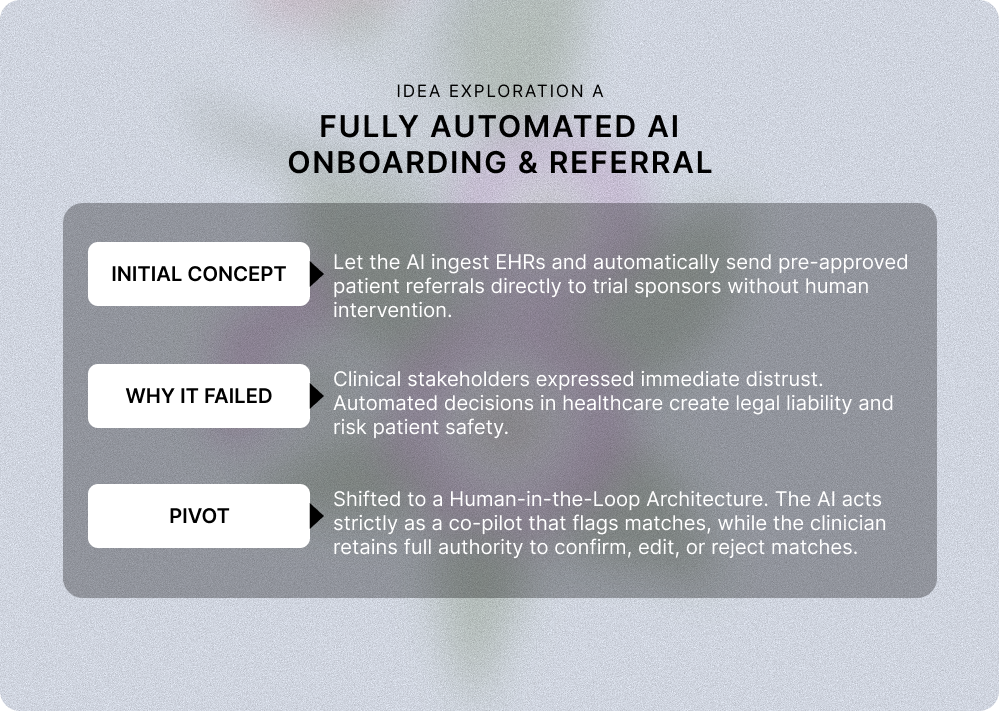
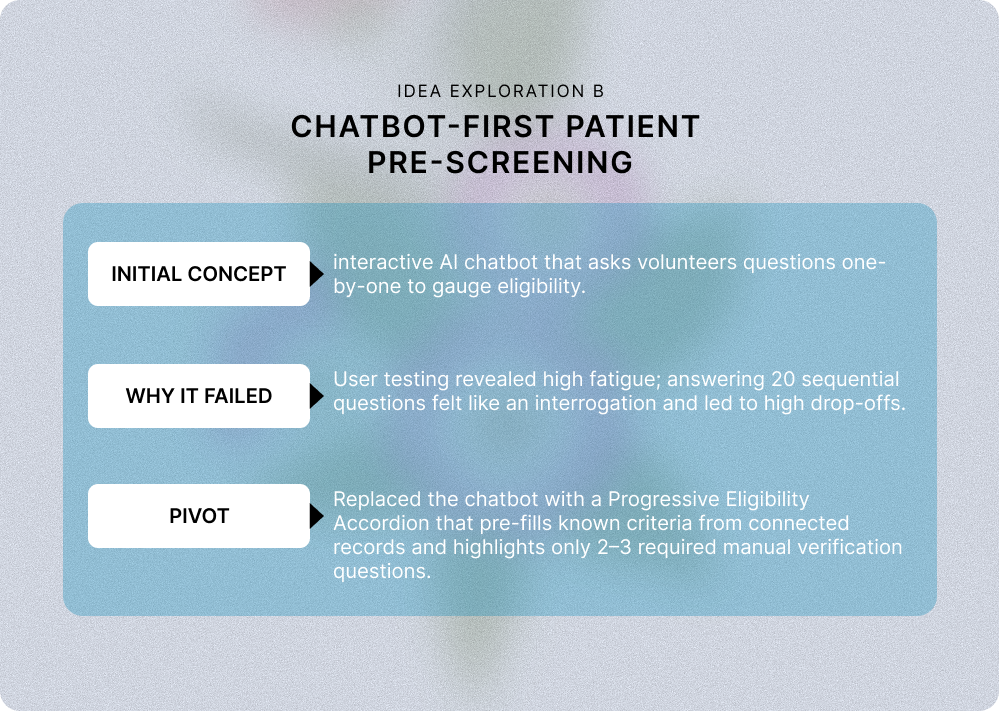
1. Grounded in Domain First: Structuring Clinical Criteria
I mapped inclusion and exclusion criteria into structured visual data blocks rather than walls of text.
- Eligibility Pill Badges: Green (Matched), and Red (Unmatched)
- Instant Logic Highlighting: Clinicians can see any eligibility criteria to see the exact EHR source data
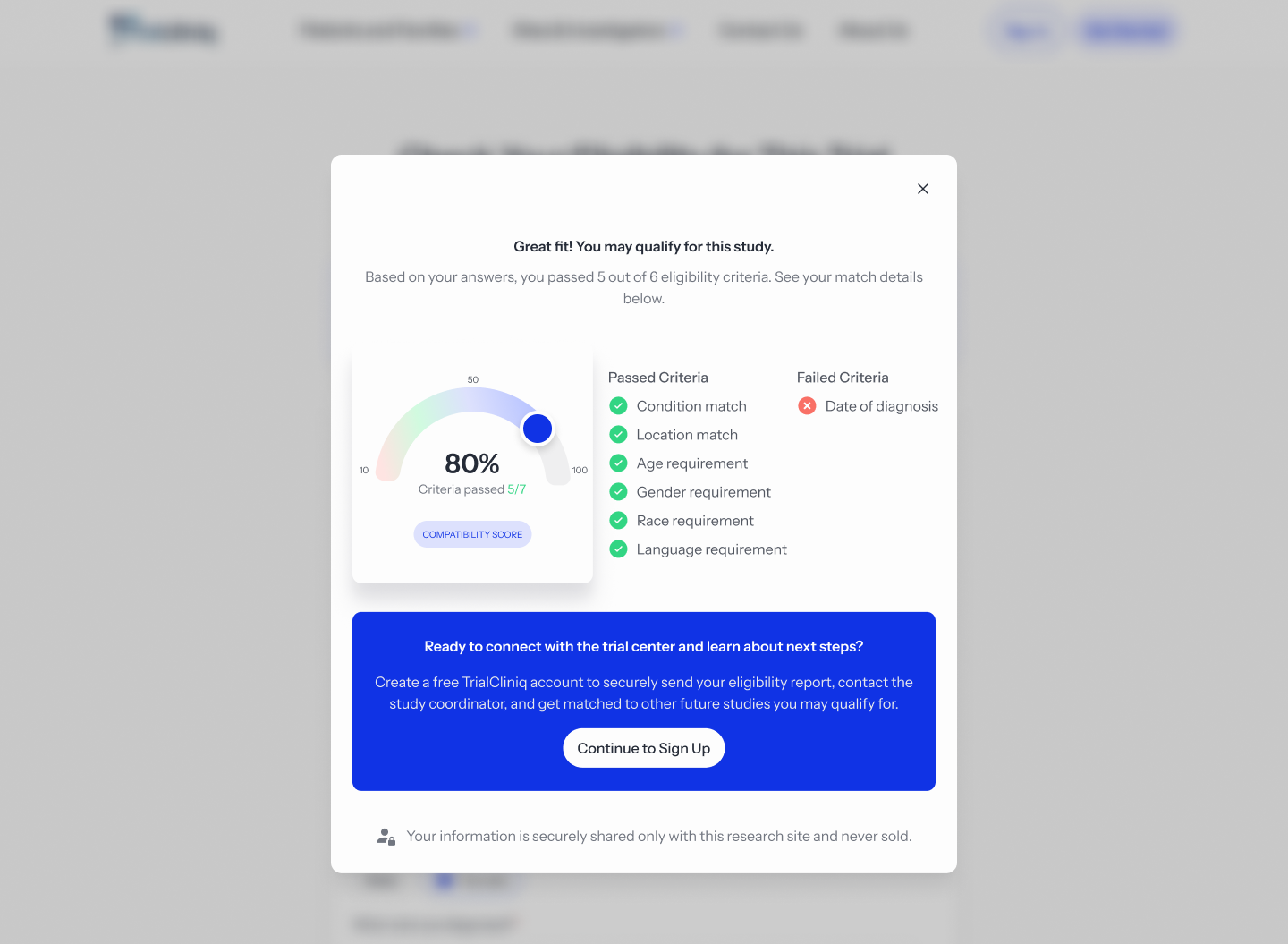
2. Progressive Disclosure & The Interrogation Drawer
To resolve the "Black Box" issue, I engineered a Layered Information Architecture
.png)
3. Dual-Dashboard Architecture
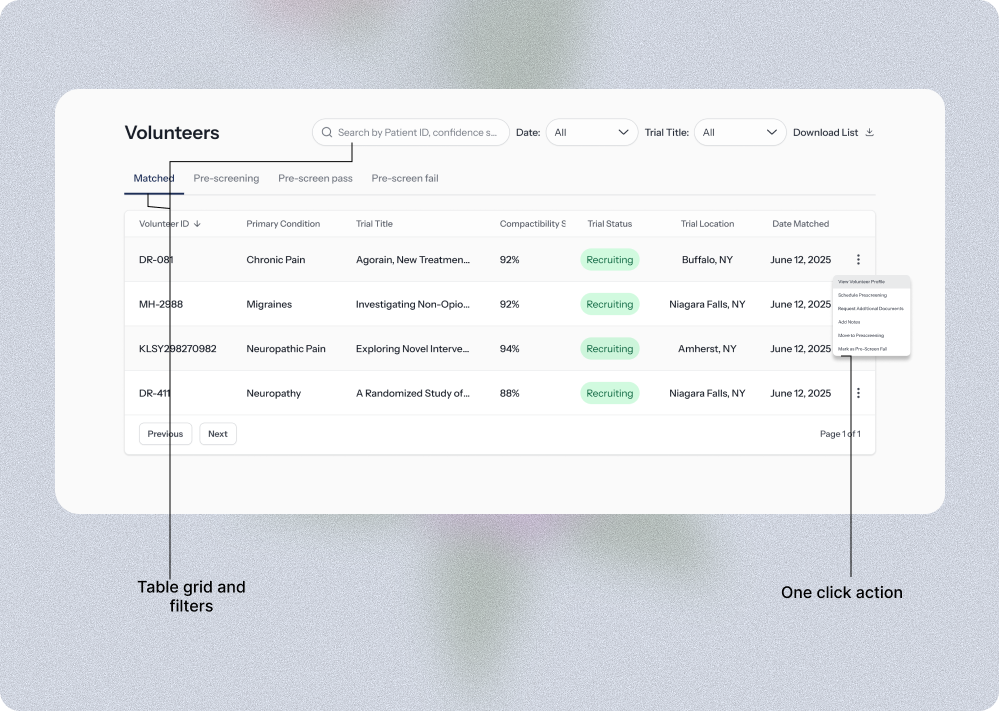
A. The Clinical Recruiter Terminal
Designed for high data density, quick keyboard shortcuts, and fast batch decisioning across multiple trial sites.
- Candidate Data Grid & Table Views: Filter candidate lists by trial status, compactibility score, or trial location.
- One-Click Actions: Schedule Prescreening, Request Additional Documents, Add Notes, and so on directly from the primary table view.
B. The Volunteer Trial Discovery Hub
Designed for accessibility (WCAG AA compliant), clear typography, and empowering patient agency.
- Plain-Language Summaries: AI translates dense medical jargon into 6th-grade reading level explanations ("This study tests a new daily pill for type 2 diabetes").
- Transparent Data Sharing: Clear consent toggles showing exactly what medical metrics are shared with trial coordinators.
.png)
TrialClinIQ is currently in pre-launch.
Impact is measured through design scope and stakeholder validation:
- 60+ screens across volunteer and recruiter experiences
- 16 core flows from trial discovery to enrollment tracking
- 2 dashboard systems designed in parallel, consistent across both user types
%20(2).gif)
.gif)
This project sits at the intersection of healthcare systems, AI, and human-centered design. My design work focused on making complex systems usable under real-world constraints.
You can also see...
Apperr Website
View ProjectGoSendeet
View Project